
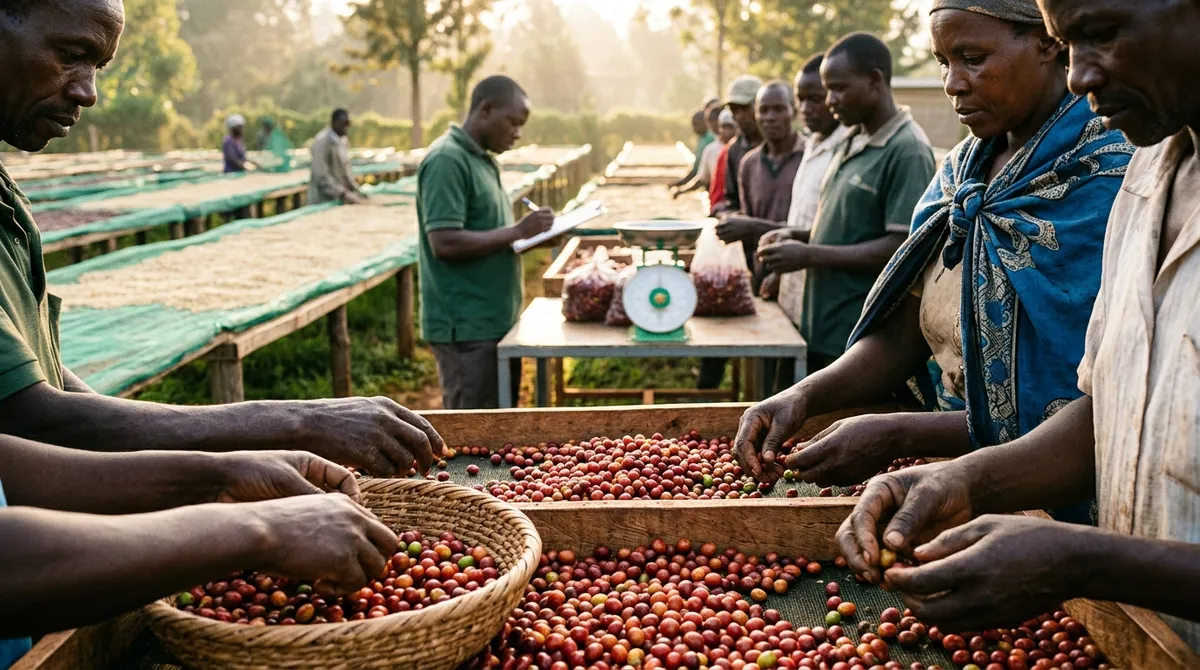
Kenyan coffee farmers and cooperative societies are seeing stronger returns from direct coffee sales, after March transactions generated about Sh1.75 billion for producers through a more transparent marketing route.
The earnings highlight the growing importance of reforms designed to shorten the distance between coffee growers and buyers. For years, farmers have raised concerns about delayed payments, unclear deductions, and weak bargaining power. Direct sales are now giving producers a clearer view of prices, buyers, and payment flows. This shift matters for smallholder farmers, who supply much of Kenya's celebrated Arabica coffee.
Direct Coffee Sales Strengthen Farmer Earnings
The March earnings show that direct coffee marketing can deliver meaningful revenue when farmers, cooperatives, and buyers work through accountable systems. Under this approach, farmers do not rely only on traditional auction channels. Instead, organized producer groups can engage buyers more directly and negotiate terms that reflect coffee quality, volumes, and market demand.
The Sh1.75 billion earned in March points to renewed confidence in Kenya's coffee value chain. It also shows that farmers can benefit when payment systems are structured to reduce unnecessary delays. Timely income helps households meet daily needs, finance farm inputs, and prepare for future production cycles.
Coffee remains one of Kenya's most important agricultural export crops. It supports rural livelihoods across counties such as Kiambu, Nyeri, Murang'a, Kirinyaga, Embu, Meru, Machakos, Kericho, Kisii, and Bungoma. When coffee payments improve, the gains spread beyond farms. Transporters, millers, factory workers, input suppliers, and local businesses also benefit from higher farm-level cash flow.
Why Direct Sales Matter in Kenya's Coffee Sector
Direct sales are not just about selling coffee outside the auction floor. They represent a broader effort to give farmers a stronger position in the market. Coffee growers often produce high-quality beans, yet many have historically received only a small share of the final value.
By connecting cooperatives and buyers more efficiently, direct sales can reduce the influence of multiple intermediaries. This can make pricing easier to understand and payments easier to track. Farmers also gain better information about the value of their coffee, especially when buyers reward quality, consistency, and traceability.
Kenyan coffee is known globally for bright acidity, complex flavor, and strong aroma. Premium buyers often seek single-origin lots from specific regions or factories. Direct marketing can help producer groups build relationships with these buyers. Over time, such links can encourage quality improvement and long-term contracts.
Cooperatives Remain Central to the Model
Cooperative societies play a major role in Kenya's coffee industry. Many smallholders own modest acreage and cannot market coffee individually at scale. Cooperatives aggregate cherries, process them into parchment, coordinate milling, and organize sales. They also help farmers access agronomy advice, credit, and inputs.
The strong March collections indicate that cooperative structures can still deliver value when supported by proper governance. However, transparency remains essential. Members need clear records on volumes delivered, milling losses, sales prices, deductions, and net payments. When cooperatives communicate this information well, trust improves.
Good management can also help cooperatives separate specialty coffee lots from ordinary grades. This is important because quality-based marketing can attract higher prices. Farmers then have a clear incentive to pick ripe cherries, reduce contamination, and follow recommended processing standards.
Faster Payments Can Transform Farm Decisions
One of the biggest frustrations among coffee growers has been slow payment. Agriculture requires predictable cash flow. Farmers must buy fertilizer, pesticides, seedlings, and labor long before they receive money from sales. Delays can push families into expensive credit or force them to reduce investment in their farms.
Direct settlement mechanisms are designed to send proceeds to farmers and their societies more efficiently. This can help producers plan better. A farmer paid on time can prune trees, apply fertilizer, and manage pests at the right stage. These actions directly affect future yields and bean quality.
Reliable payments can also encourage young people to view coffee as a viable business. Many rural youth have avoided the crop because of low returns and uncertainty. If reforms continue improving income visibility, coffee farming could become more attractive to the next generation.
Quality Will Determine Long-Term Gains
Higher earnings from direct coffee sales are encouraging, but sustained success will depend on quality. Kenya competes in a global market where buyers compare origin, cup profile, consistency, certification, and price. Farmers and cooperatives must therefore focus on production standards from the farm to the factory.
Selective picking remains a key starting point. Ripe red cherries produce better coffee than mixed harvests. Proper fermentation, washing, drying, and storage also protect quality. Poor handling can reduce grade and lower prices, even when the crop comes from a famous coffee region.
Extension services can support this effort by training farmers on soil health, disease control, rejuvenation, and climate-smart practices. Many coffee trees in Kenya are old and less productive. Replanting and rehabilitation can raise output, but farmers need affordable seedlings and technical guidance.
Market Reforms Need Strong Oversight
The growth of direct sales should continue alongside strong regulation. Transparent rules protect farmers, buyers, cooperatives, and the reputation of Kenyan coffee. Every participant in the value chain needs confidence that contracts, payments, grading, and licensing are handled fairly.
Oversight is especially important where large sums are involved. With March earnings reaching about Sh1.75 billion, accurate documentation becomes critical. Farmers should know how much coffee was sold, at what price, and when the money was received. Clear records reduce disputes and discourage misuse of funds.
Digital payment systems can strengthen accountability. They create trails that help track transactions from buyer payments to cooperative accounts and farmer disbursements. When combined with regular audits, digital records can improve confidence across the sector.
Export Demand Offers Fresh Opportunities
Kenya's coffee enjoys strong recognition in specialty markets across Europe, North America, Asia, and the Middle East. Buyers value its distinctive cup profile and high grading standards. Direct sales can help farmers capture more of this demand, especially when cooperatives market traceable lots with unique regional identities.
Traceability is becoming more important in global trade. Roasters and consumers increasingly want to know where coffee comes from and how farmers are treated. Producer groups that can provide accurate information on origin, processing, and sustainability may gain a competitive edge.
Climate also shapes market prospects. Changing rainfall patterns, rising temperatures, and new pest pressures threaten coffee production in many regions. Farmers who adopt resilient practices will be better placed to meet buyer expectations and maintain quality. These practices include shade management, water conservation, soil testing, and disease-tolerant varieties.
What Farmers Need Next
The March performance is a positive signal, but farmers need consistent progress. Better earnings in one month should translate into long-term sector improvements. This requires fair pricing, predictable settlements, stronger cooperatives, and wider access to market information.
Financial literacy is also important. When farmers understand deductions, loan obligations, and payment schedules, they can make better decisions. Cooperatives can support members through regular meetings, simplified statements, and transparent communication.
Access to affordable credit remains another priority. Coffee farming is seasonal, while household needs are constant. Farmer-friendly credit can help producers avoid distress sales and invest in productivity. However, borrowing must be tied to realistic repayment plans and transparent deductions.
Conclusion
The Sh1.75 billion earned from direct coffee sales in March marks an important moment for Kenyan coffee farmers and cooperative societies. It demonstrates the potential of market reforms that prioritize transparency, timely payments, and stronger producer participation. If supported by good governance, quality improvement, and reliable oversight, direct sales can help farmers earn better returns from one of Kenya's most valuable crops.