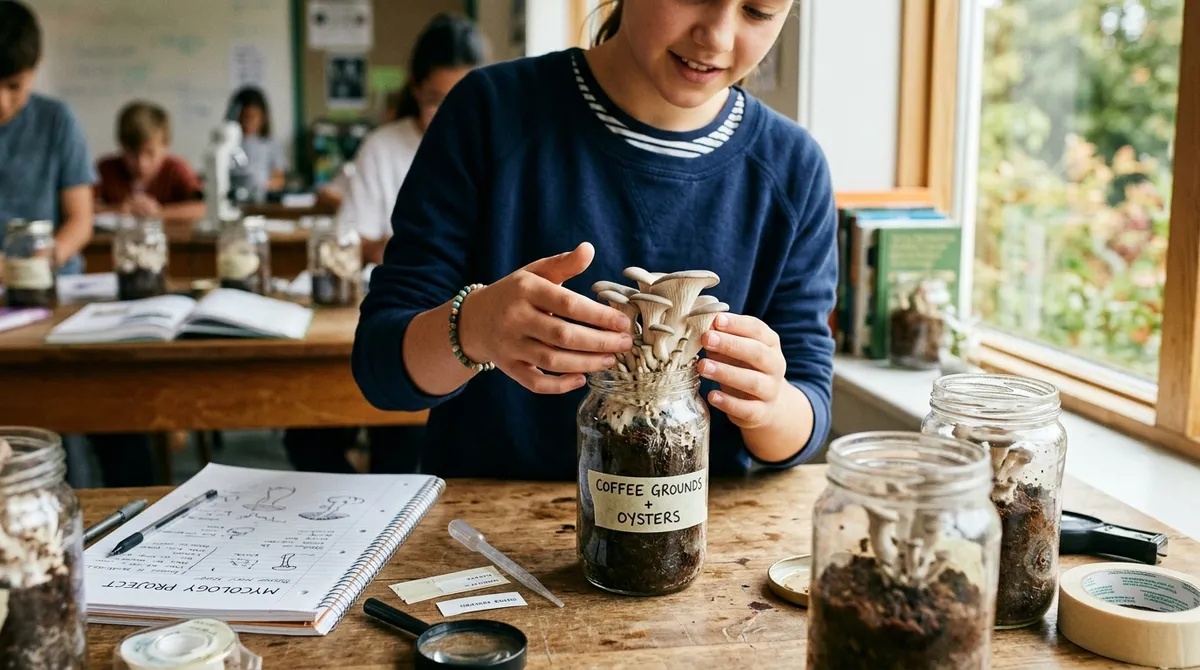
A middle school science project can start with something as ordinary as a cup of coffee. For one eighth grader, used coffee grounds became the foundation for an experiment in growing mushrooms, reducing waste, and showing how young innovators can turn everyday leftovers into something useful.
Turning coffee waste into a growing medium
Spent coffee grounds usually go straight into the trash after brewing. Yet those dark, damp grounds still contain organic material that can support new life. In this project, an eighth-grade student explored how coffee waste could be reused as a substrate for mushroom cultivation.
The idea is simple but powerful. Coffee grounds are rich in nutrients, widely available, and often discarded in large amounts. By using them to grow edible fungi, the student connected science, sustainability, and food production in a way people can understand quickly.
Mushrooms do not grow like garden vegetables. They feed on decomposing organic matter. That makes them ideal candidates for experiments involving reused materials. Coffee grounds can provide a workable base when handled properly, especially for mushroom varieties that thrive on plant-based waste.
Why coffee grounds are useful for mushrooms
Used coffee grounds contain nitrogen, moisture, and fine particles that mushroom mycelium can colonize. Mycelium is the hidden network of fungal threads that spreads through a growing medium before mushrooms appear above the surface.
In a successful setup, the mycelium moves through the coffee grounds and breaks down complex organic compounds. Over time, that process supports fruiting, which is when visible mushrooms begin to develop.
However, coffee grounds also create challenges. They hold moisture well, but too much moisture can invite mold. They can pack tightly, which limits airflow. They may also contain competing microbes if they are not collected, stored, and prepared carefully.
Those challenges make the project a strong learning experience. It is not only about whether mushrooms grow. It also teaches observation, sanitation, patience, and problem solving.
A hands-on lesson in circular sustainability
The project highlights a key idea in circular sustainability. Instead of treating waste as the end of a product's life, people can redirect it into another useful process. Coffee grounds become a resource rather than garbage.
This matters because food-related waste is a major environmental issue. Coffee shops, cafeterias, offices, and homes generate spent grounds every day. When organic waste ends up in landfills, it can contribute to greenhouse gas emissions as it decomposes without enough oxygen.
Reusing coffee grounds for mushroom cultivation offers a small but meaningful alternative. It keeps material in use longer. It also demonstrates how local waste streams can support local food systems.
For students, this kind of experiment makes sustainability visible. It moves the topic away from abstract warnings and into a container they can monitor, measure, and improve.
STEM education with real-world impact
An experiment like this fits naturally into STEM education. It involves biology, environmental science, data collection, and design thinking. Students can ask a research question, form a hypothesis, track conditions, and evaluate outcomes.
Important variables include moisture level, amount of mushroom spawn, container type, light exposure, temperature, and cleanliness. Students can compare different batches and record which conditions produce the healthiest mycelium or best mushroom growth.
The project also introduces systems thinking. Coffee consumption, waste management, fungal biology, food production, and composting all connect. When students see those links, they gain a deeper understanding of how science works outside textbooks.
That practical connection can be especially motivating. Many young people care about climate solutions, local food, and reducing waste. A mushroom-growing project gives them a direct way to participate.
How mushroom cultivation works
Growing mushrooms begins with spawn, which is material already colonized by mushroom mycelium. The spawn is mixed into a prepared substrate, such as coffee grounds, straw, sawdust, or another organic base.
Once mixed, the material needs the right balance of moisture, oxygen, and temperature. If conditions are favorable, mycelium spreads through the substrate. This stage is often called colonization.
After colonization, the grower changes conditions to encourage fruiting. Depending on the mushroom type, that may involve fresh air, humidity, indirect light, or a temperature shift. Small pins appear first. Those pins can then expand into harvestable mushrooms.
Coffee ground projects often focus on oyster mushrooms because they are known for growing on many agricultural byproducts. They are also relatively fast compared with some other edible mushrooms.
Safety and cleanliness are essential
While the concept is approachable, safe mushroom cultivation requires care. Coffee grounds should be fresh, and containers should be clean. Delays can allow unwanted mold or bacteria to take hold before mushroom mycelium gets established.
Anyone growing mushrooms should use a known edible species from a reliable supplier. Wild mushroom identification is a separate skill and can be dangerous without expert guidance. A school project should never rely on unidentified fungi.
Students should also avoid eating experimental mushrooms unless an adult with proper knowledge confirms the species, growing process, and safety. In many classrooms, the educational value comes from observation rather than consumption.
These precautions do not reduce the value of the project. They strengthen it. Good science depends on controlled methods, careful handling, and clear records.
What young innovators can teach communities
One of the strongest parts of this story is the student's age. An eighth grader using coffee grounds to grow mushrooms shows that environmental problem solving is not limited to professionals, labs, or large companies.
Young people often notice problems adults overlook. They may question why useful materials are discarded. They may also be willing to test unconventional ideas with curiosity and persistence.
Projects like this can inspire schools to rethink cafeteria waste, science fairs, garden clubs, and partnerships with local businesses. A coffee shop could provide grounds. A classroom could test growing methods. A garden program could compost leftover substrate after harvest.
That cycle creates community learning. It also introduces students to careers in agriculture, biotechnology, environmental science, sustainability, and food systems.
From small experiment to bigger conversation
The mushroom project also points toward larger trends in sustainable agriculture. Around the world, growers and researchers are looking for ways to produce food with fewer resources and less waste.
Mushrooms are part of that conversation because they can grow on materials humans cannot eat directly. Agricultural byproducts, wood waste, and other organic leftovers can become inputs for fungal production.
After mushrooms are harvested, the remaining substrate may still have value. In many cases, it can be composted or used to enrich soil, depending on the material and local guidelines. That creates another loop in the waste reduction process.
Although a student project is small in scale, it helps people imagine broader possibilities. If one container of coffee grounds can support mushroom growth, communities can ask what other discarded materials might be reused creatively.
Why this project resonates
The appeal of this experiment comes from its accessibility. Coffee grounds are familiar. Mushrooms are familiar. The transformation between them feels surprising, but it is grounded in basic biology.
That combination makes the project easy to share and discuss. Parents, teachers, students, gardeners, and local businesses can all see a role for themselves. It turns sustainability from a distant goal into a practical activity.
It also challenges the idea that innovation must be complicated. Sometimes meaningful innovation begins with asking a better question. In this case, the question is what happens if we stop seeing coffee grounds as trash.
A fresh example of student-led sustainability
An eighth grader's mushroom-growing project offers more than a clever science fair idea. It shows how observation, experimentation, and environmental awareness can come together in a practical way.
By repurposing coffee grounds, the student demonstrated a simple path toward waste reduction and hands-on STEM learning. The project also encouraged a wider conversation about food systems, local resources, and the value hidden in everyday leftovers.
Small experiments can spark big ideas. With curiosity and careful testing, even a used scoop of coffee grounds can become the starting point for science, sustainability, and community change.